

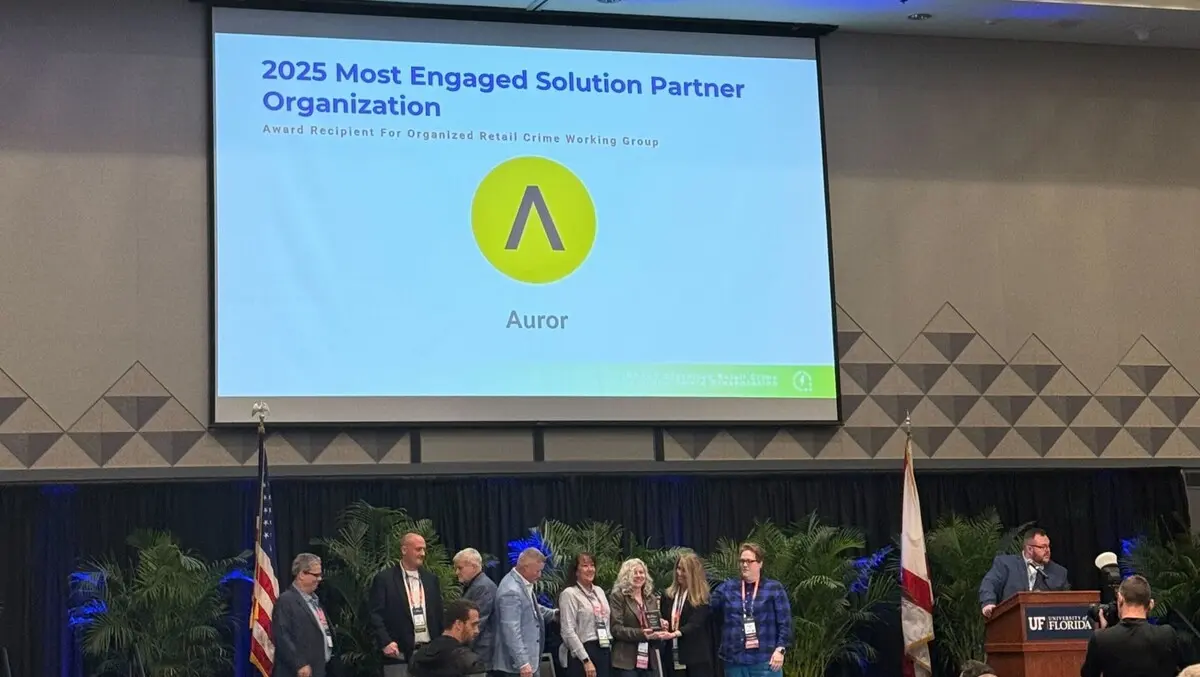
Auror named LPRC's most engaged partner on retail crime
Wed, 25th Mar 2026
Auror has been recognised by the Loss Prevention Research Council as its Most Engaged Solution Partner for work with retailers and law enforcement in the United States on organised retail crime.
The recognition reflects Auror's involvement in the LPRC's organised retail crime working group, where retailers, researchers and police agencies examine theft patterns and share investigative approaches. The council said Auror had remained closely engaged as the group worked on evidence-based responses to repeat offending.
Auror develops software that retailers use to log incidents and share information with police. According to the company, the platform is used in more than 85,000 stores worldwide and by more than 3,500 law enforcement agencies across North America, the UK, Australia and New Zealand.
In the US, Auror has recently focused much of its work on organised retail crime, an issue drawing growing attention from retail groups, police departments and federal agencies. Retailers argue that a relatively small number of repeat offenders and criminal networks account for a disproportionate share of losses and violent incidents.
Auror said it is one of 165 solution partners working with the LPRC and its retail members, which include CVS, Ulta Beauty, Target, Kroger, Lululemon and IKEA, alongside law enforcement bodies involved in retail crime investigations.
Crime patterns
Auror pointed to its retailer data in arguing that offending is highly concentrated among a small group of repeat suspects. Analysis cited by one of its senior executives suggests the top 10 per cent of offenders are linked to more than 66 per cent of retail crime in the US.
That finding is central to current efforts by retailers and investigators to target repeat offenders rather than treat incidents as isolated shoplifting cases. Industry groups increasingly describe organised retail crime as a broader problem involving resale networks, cross-state activity and, in some cases, violence against shop staff.
Raul Aguilar, Auror's Head of Law Enforcement for the Americas, said the company's approach centres on building links between retail security teams and police investigators.
"We're focused on building meaningful partnerships and doing whatever we can to bring our frontline partners together to tackle this problem as one," said Aguilar.
He added that US retailers were facing a high volume of serious offending.
"It's a privilege to be working alongside our partners to find new solutions to the high-volume, violent and organised crime problem that US retailers are facing," said Aguilar.
Aguilar said organised retail crime was driven by a relatively small group of prolific offenders.
"Organised retail crime is a violent, brazen and even transnational problem driven by a small group of prolific and violent offenders. Our Auror retailer data shows the top 10% of offenders are responsible for more than 66% of retail crime in the US, so it's critical the community comes together to explore new ways of identifying and focusing efforts on this group of high-harm offenders," added Aguilar.
Industry focus
The LPRC is a research body focused on theft, loss prevention and store safety. Its working groups typically bring together retailers, academics, technology suppliers and law enforcement to test methods for reducing crime in stores and along supply chains.
Recognition from the council raises Auror's profile in a market where retailers are under pressure to show they are responding to theft and violence more systematically. Retail crime has become a board-level issue for many chains, particularly where theft is linked to assaults on workers, repeat visits by the same suspects or larger fencing operations.
Auror cited a case from Texas as an example of how retailer information can feed into wider investigations. It said retailer data helped uncover a major organised crime ring linked to 28 other states and more than 190 offenders, with an estimated USD $1 billion in stolen goods since 2019 across major retailers.
The example reflects a broader shift in how retail theft is investigated. Rather than relying only on single-store reports, chains and police are increasingly trying to connect data across regions to identify repeat names, methods and routes for stolen goods.
LPRC Director of Research Dr. Cory Lowe commented on Auror's role in that work.
"LPRC appreciates Auror's engagement and support of the ORC Working Group and the LPRC, as well as the work Auror does to address organised and violent retail crime in the United States and beyond," said Lowe.