

Exclusive: Cloudera CPO, SVP reveal how they give customers 'clarity'
Sun, 28th Sep 2025
At EVOLVE25, Cloudera's flagship data and AI conference in New York, the company's leadership made one thing clear: in an era of AI overload and cloud chaos, customers are craving clarity - and Cloudera intends to deliver it.
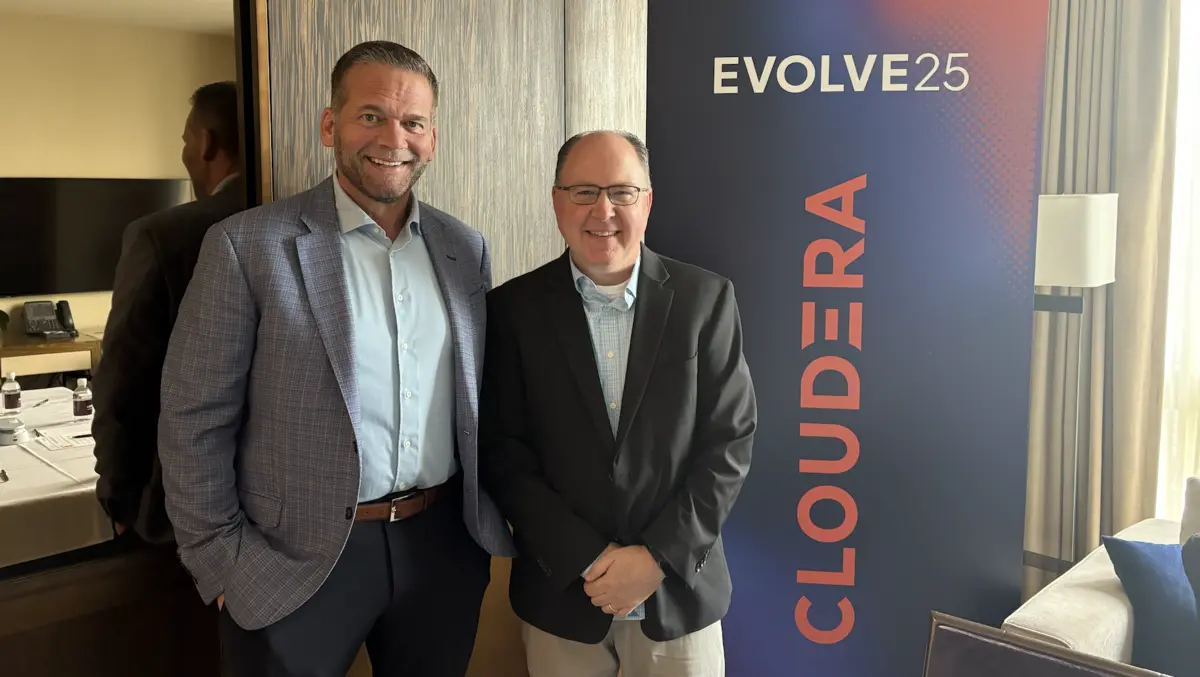
Speaking during the event at the Glasshouse NYC on 25 September, Chief Product Officer Leo Brunnick and SVP of Product Marketing Jeff Healey explained how Cloudera is positioning itself as the connective tissue in the modern enterprise AI ecosystem.
With a $300 million investment in R&D and acquisitions, the company is focused on enabling enterprises to harness the full potential of AI - without ripping and replacing their existing infrastructure.
"They're not asking for perfect - they're asking for clarity," Brunnick said. "And we give them that clarity without requiring a three-year clean-up plan."
That theme of clarity ran through the entire conversation - from product strategy to AI enablement to how Cloudera engages with its customers.
Clarity through customer-first thinking
Brunnick, who joined Cloudera as CPO in March, has already restructured the company's engineering org around customer outcomes. Previously, teams were organized by technology stack - "I build Spark" - rather than by the problems customers needed solved.
"Now, when something breaks, there's a team that owns that product end to end," Brunnick explained. "It's changed how we work with customers."
This shift is about helping enterprises make sense of increasingly complex environments made up of legacy systems, cloud platforms, and hybrid deployments.
"We understand that nobody has the estate they wish they had," Brunnick said. "These environments are the result of acquisitions, legacy systems, and years of decisions. Our job is to make sense of that - not force customers to change it."
Clarity through interoperability
Interoperability is central to Cloudera's value proposition. Rather than pushing a lift-and-shift model to a single cloud provider, Cloudera is investing in tools and standards that bridge environments - so data and AI workloads can move freely, with governance and security intact.
"That approach - of telling people to move everything to one cloud - is over," said Healey. "What customers need is the ability to access, govern, and trust their data - wherever it lives."
To that end, Cloudera has made key acquisitions like Octopai for data lineage, and is supporting open standards like Apache Iceberg to ensure seamless interoperability across platforms.
Clarity through governed AI
AI isn't just part of Cloudera's roadmap - it's baked into its platform. But the company is taking a measured, governance-first approach.
With new offerings like Cloudera AI Studio, enterprises can now build agentic AI using low-code tools, while ensuring that the data behind those agents is accurate, trusted, and traceable.
"We're not building AI models," Healey clarified. "We support them - whether open source or proprietary. Our role is to ensure that the data feeding those models is secure, governed, and complete."
The emphasis on trust is especially critical for Cloudera's customers in regulated industries like banking, where compliance is non-negotiable.
"It's why eight of the top ten global banks run on Cloudera," Healey said. "You can't afford hallucinations or breaches in those environments."
Clarity in complexity
Brunnick described today's enterprise tech environment as one caught between two eras - control and convenience. The next era, he argued, is about convergence: blending flexibility with oversight.
"Enterprises want the easy button," he said, "but they also need compliance, performance, and governance."
That's where Cloudera sees its role - not as a replacement for existing tools, but as the glue that gives enterprises visibility across their data landscape.
"We offer the bridge," Healey added. "Many customers are stuck between hyperscaler cloud and on-prem. We give them a way to connect and control both."
With Octopai, Cloudera can now map data lineage across the entire estate - offering a level of transparency that's critical to building ethical, responsible AI.
"Bad data in means bad results out," Healey said. "That's why governance is foundational."
Clarity in the age of AI agents
Healey noted that many customers are moving beyond chatbots toward autonomous agents that can automate real business processes. But to do that effectively, those agents need access to clean, governed data.
"Our hands-on labs are full," Healey said. "Customers are ready for this, and they're not just experimenting - they're production-minded."
Brunnick echoed this, emphasizing that AI at Cloudera is about empowering people, not replacing them.
"We're investing in tools like AI assistants to make analysts more productive," he said. "Not to replace them, but to let them do more."
Healey pointed to offerings like SQL AI Assistants and Cloudera AI Studio as examples of embedding AI directly into the data workflow - eliminating friction and enabling faster insights.
"Your vendor should be bringing AI into the platform itself," he said. "If they're not, it's time to rethink your strategy."
As Cloudera looks ahead, it's betting on hybrid cloud, governed AI, and open interoperability - not to simplify the complexity of enterprise data, but to illuminate it. In other words, to give customers clarity.