

.webp)
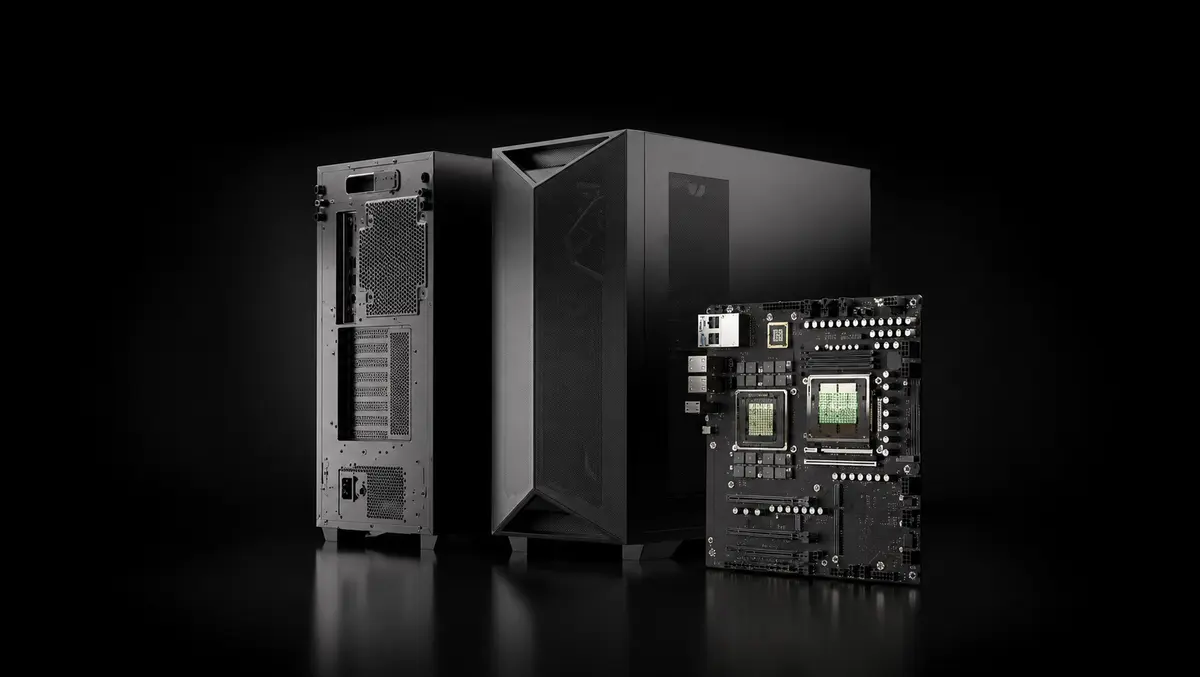
MSI has begun shipping the XpertStation WS300, a deskside AI system based on NVIDIA DGX Station architecture. It is available through ASI, D&H and Newegg.
The system uses NVIDIA's GB300 Grace Blackwell Ultra Desktop Superchip and is aimed at local AI development and deployment inside businesses. MSI says it combines up to 748GB of coherent memory with dual 400GbE networking through NVIDIA ConnectX-8 SuperNIC, allowing two WS300 units to be clustered for larger AI workloads.
The launch reflects growing demand for on-premises AI infrastructure as companies look to run larger models closer to their own data. That demand has risen as AI use shifts from smaller chatbot-style applications to larger language models and autonomous agents that require more memory, more inference and continuous operation.
MSI is positioning the machine as a way to move AI work out of remote cloud environments and into local systems under a company's own control. It says this can help organisations retain control of proprietary data and models while reducing recurring cloud inference spending.
Danny Hsu, general manager of enterprise platform solutions at MSI, made that case in comments released alongside the launch.
"Enterprises don't just need powerful AI systems; they need a straightforward way to bring them into production," Hsu said.
"XpertStation WS300 is designed around that reality, a system that's ready to run demanding AI workloads the moment it arrives, not one that requires months of additional integration."
Local AI focus
According to MSI, the WS300 is built for large-scale AI development, fine-tuning, multimodal AI and local inference. By keeping larger foundation models resident in coherent memory, the system is intended to reduce data movement between the CPU and GPU and improve inference efficiency.
The ability to cluster two systems through dual 400GbE links suggests MSI is targeting customers that want to start with a single deskside system and expand in a limited way without immediately moving to full data-centre deployments. Pricing was not disclosed in the announcement.
NVIDIA presented the product as part of a broader shift in enterprise AI computing from experimental use to continuous production workloads. The trend has increased interest in systems that can sit in office or lab environments while still handling large models and agent-based software.
"AI is moving from experimentation to always-on, agentic workloads that demand powerful computing close to where developers and enterprise data reside," said Allen Bourgoyne, director of enterprise products at NVIDIA.
"With XpertStation WS300 based on NVIDIA DGX Station architecture, MSI is bringing NVIDIA Grace Blackwell Ultra computing to the deskside, giving enterprises the performance and scale to develop, customize and run advanced AI models and agents locally."
Agent systems
MSI also says the WS300 supports NVIDIA NemoClaw with the NVIDIA OpenShell runtime. It describes this as a way to run policy-controlled autonomous AI agents within enterprise environments, extending the machine's use beyond model development into operational deployments.
That places the WS300 in a part of the market where vendors are trying to offer systems for both building AI models and running them inside business processes. The emphasis on agentic AI reflects a broader industry move towards software that can act with a degree of autonomy rather than only responding to prompts.
MSI, which sells products across gaming, business computing and servers, says its server products are developed in-house. The company operates in more than 130 countries, and the WS300 launch adds to a growing list of hardware makers seeking to capture enterprise AI spending with systems smaller than traditional data-centre installations.
The rollout through established distribution channels in North America suggests MSI is seeking broad commercial access rather than a limited direct-sales approach. For buyers weighing cloud-based AI services against local hardware, the WS300 enters the market as vendors and customers continue to debate where AI workloads should run and who should control the underlying infrastructure.